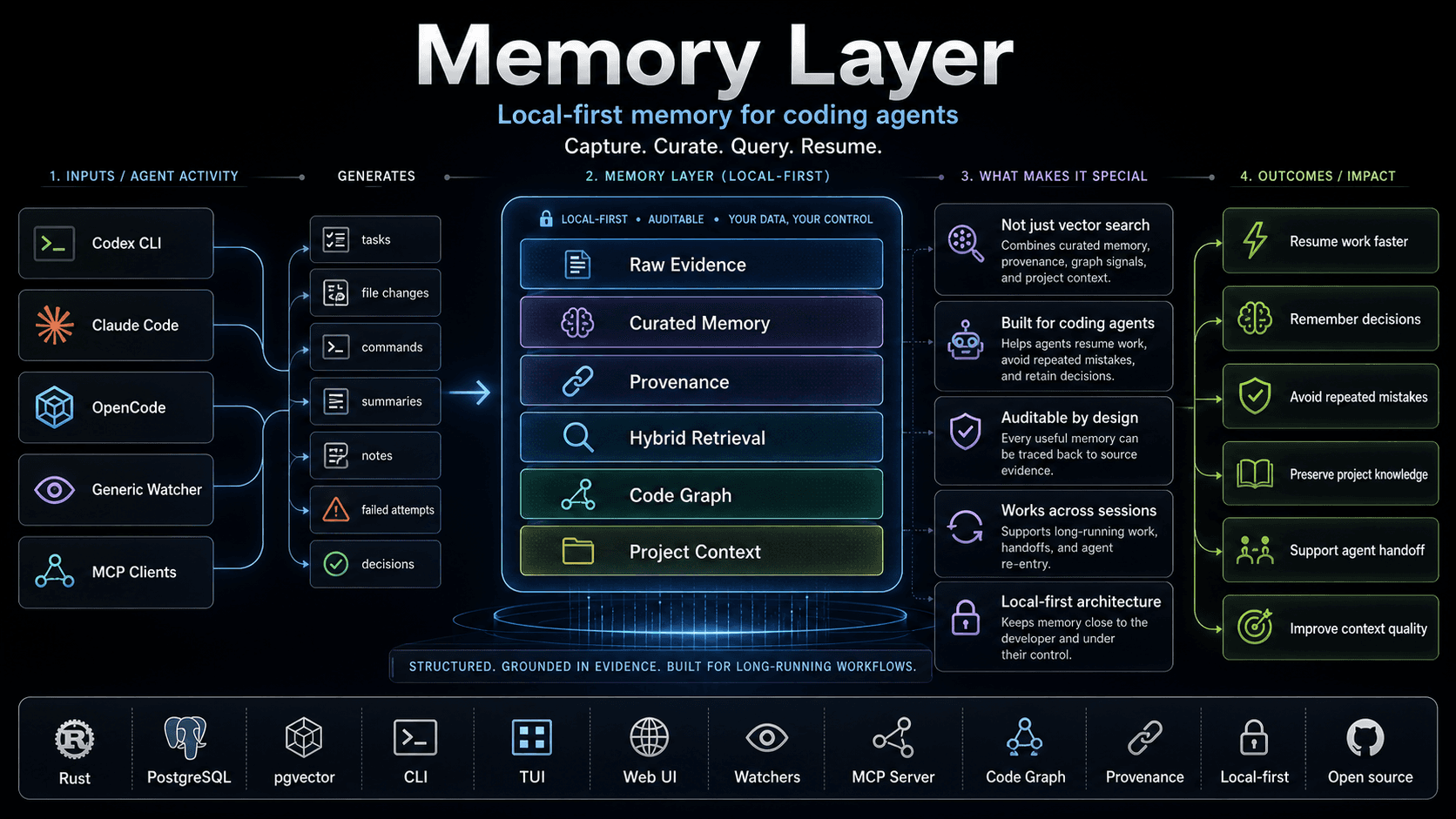
Memory Layer
Memory Layer gives coding agents persistent, project-scoped memory. It captures decisions, context, and rationale from each session, curates them to remove duplicates and noise, and stores the results in a graph and vector database so future sessions can recall what matters and how it connects. Frequently used memories are re-validated against your code, so what agents recall stays accurate as the project moves. It works with Codex, Claude Code, OpenCode and the OpenAI, Voyage and Ollama embedding APIs.
Memory Layer v2.0.0 is available. New installs can start below. Existing v1 installations should read the v2 update guide because the release changes configuration, API, authentication, bundle, and CLI boundaries. Read the release notes.
Try it
Start with the demo stack and see the system working end to end.
Quickstart
Run a single reproducible demo with Docker, seed the demo project, and ask one question.
Install
Set up Memory Layer for a real machine or repository.
Daily workflow
Capture, query, resume, inspect, and recover once the stack is running.
Use it in a project
TUI
Browse memory, query results, review proposals, and runtime state from the terminal.
Web UI
Inspect the same data in a browser with wider panes and the graph view.
Agents
Connect Codex, Claude Code, OpenCode, or your own agent to project memory.
Codex plugin
Connect Codex Desktop through the supported MCP and workflow-skill package.
Recipes
Copy-ready setups for note vaults, research corpora, games, home automation, and AI chats.
Help
Find symptom-led troubleshooting, FAQs, and support routes.
Understand it
How it works
Learn the mental model behind capture, curation, retrieval, and reinforcement.
Watchers
See how background capture and automation loops stay aligned with the repository.
Automations
Review the built-in loop workflows that keep memory hygiene and triage moving.
MCP
Use the protocol surface when an agent prefers tools over direct CLI calls.
Operations
Run Memory Layer safely, upgrade it, back it up, and recover it.
Evals
Check how Memory Layer is tested and scored.
Reference
Look up commands, APIs, config, environment variables, and exit codes.
Classroom
Follow the conceptual lessons that explain the memory model.
Roadmap
See where the project is going next.